
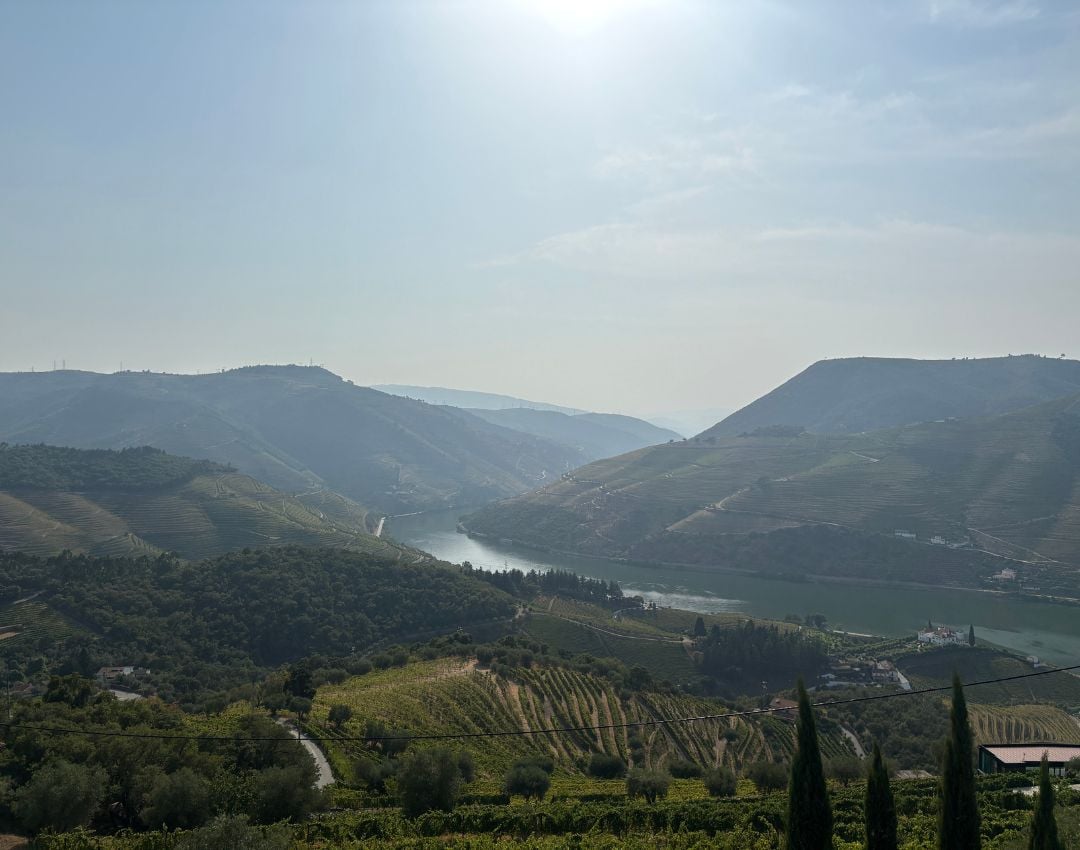

Plein air painting while traveling often comes with its own set of challenges, and my recent trip to Portugal’s Douro Valley was no exception. The landscape—lined with grapevines and layered with hazy hills—was beautiful, but also unfamiliar. I made a couple of small plein air painting studies while there, and in the process was reminded of a few important lessons about painting landscapes that are worth passing along.
Below are two key lessons I took away, with examples from the paintings I created on-site.
1. Check Your Values from a Distance—Even When You Can’t Step Back
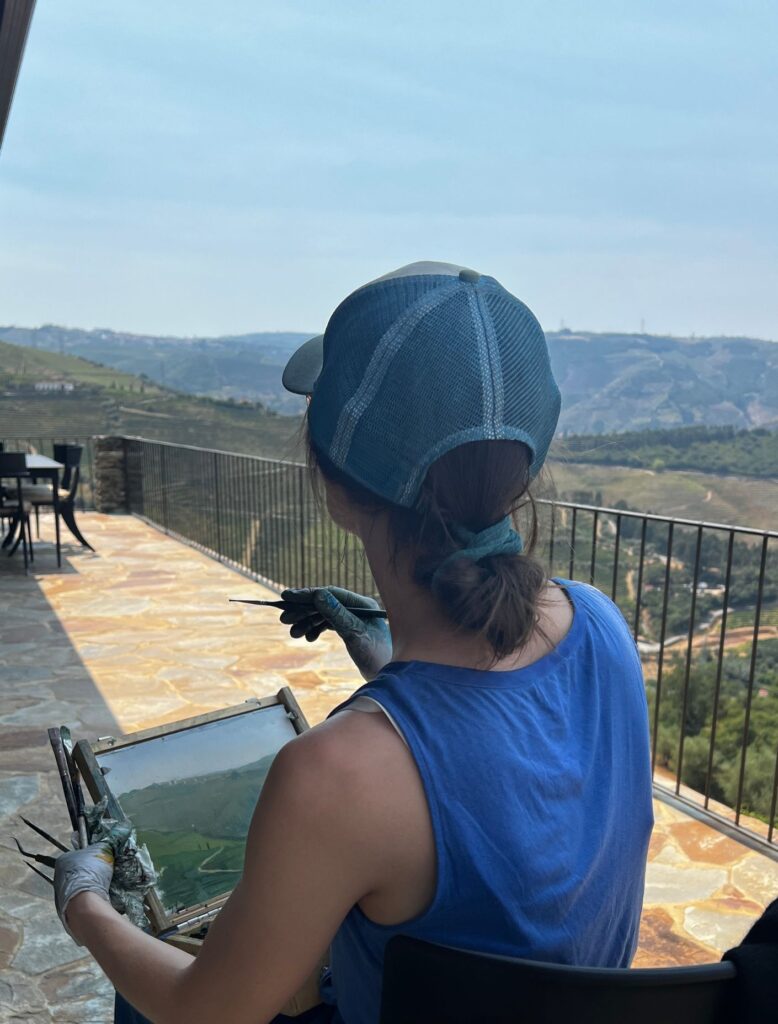
One challenge of painting en plein air—especially when traveling—is not always having the ideal setup. Without a tripod (in an effort to travel light with art supplies), I painted with my small 8×10” Guerrilla Painter box on my lap. This made it difficult to step back and view the work from a distance while painting, something that proved costly on the first piece.
Once indoors, it became immediately clear: the foreground looked overly saturated and disconnected from the more subtle, hazy hill in the background. The foreground felt like it belonged to an entirely different painting.
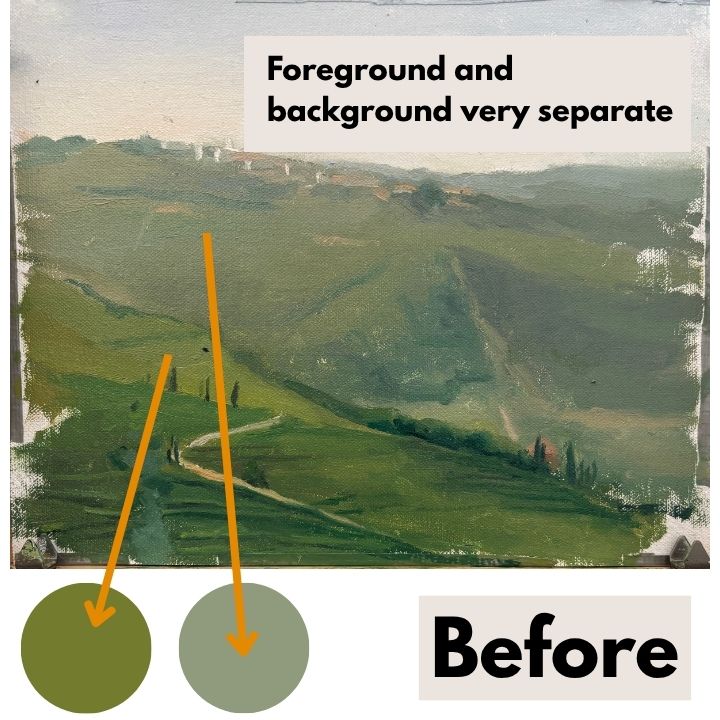
Lesson:
Even when working small or in limited conditions, find a moment to evaluate your painting from a distance—or take a quick photo and view it on your phone. It’s one of the fastest ways to spot value or color relationships that feel off.
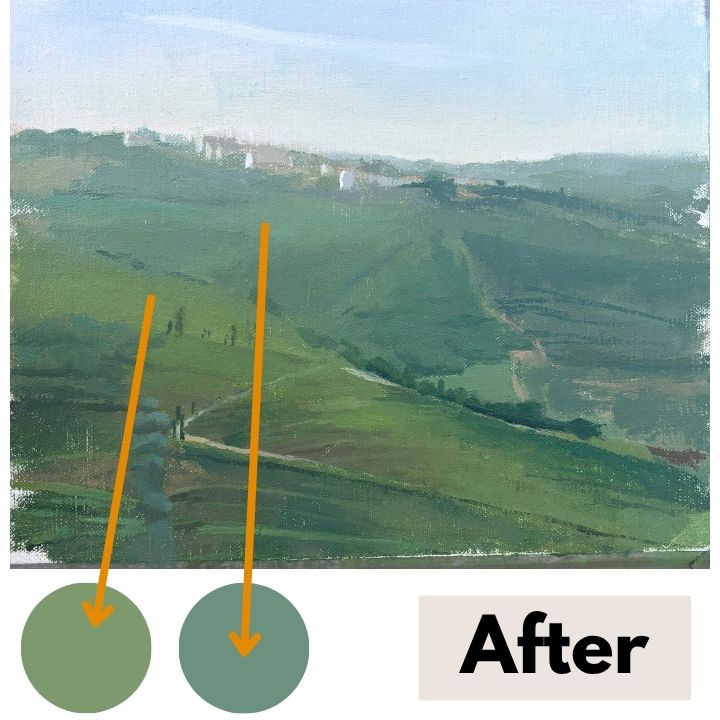
Fix:
I worked on this painting again on a different day. This time I used a wine box given to me by a local wine merchant. I made sure to step back this time and compare the different parts of the painting to one another. To unify the composition, I toned down the foreground values and added just a bit more brightness and cooler greens to the distant hill, which helped bring everything back into balance.
2. Subtlety Can Be More Powerful Than Boldness
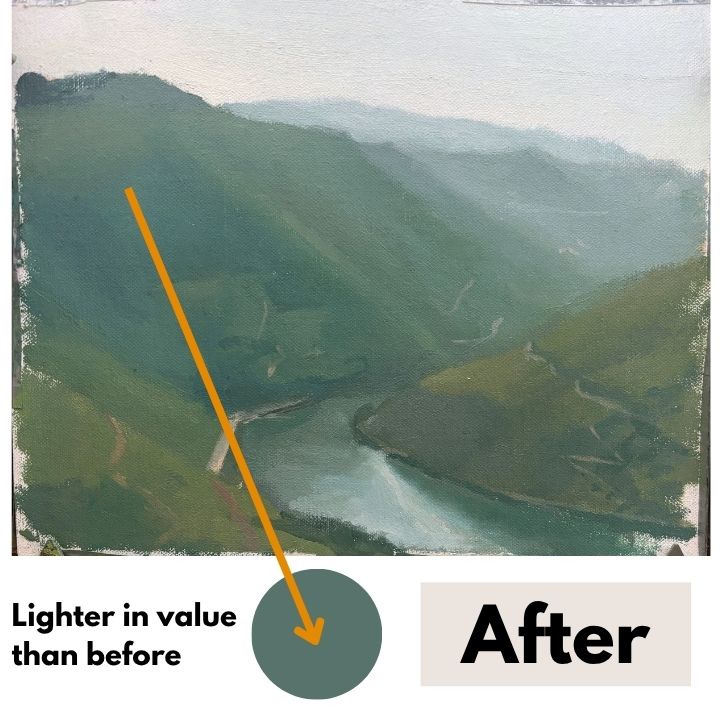
The second painting featured the Douro River as its main subject. My first attempt leaned too dark and lost the delicacy of light and air that made the view so striking when I saw it in person. The temptation to punch up contrast or overdefine forms can be strong—especially when working quickly—but it often strips away atmosphere.
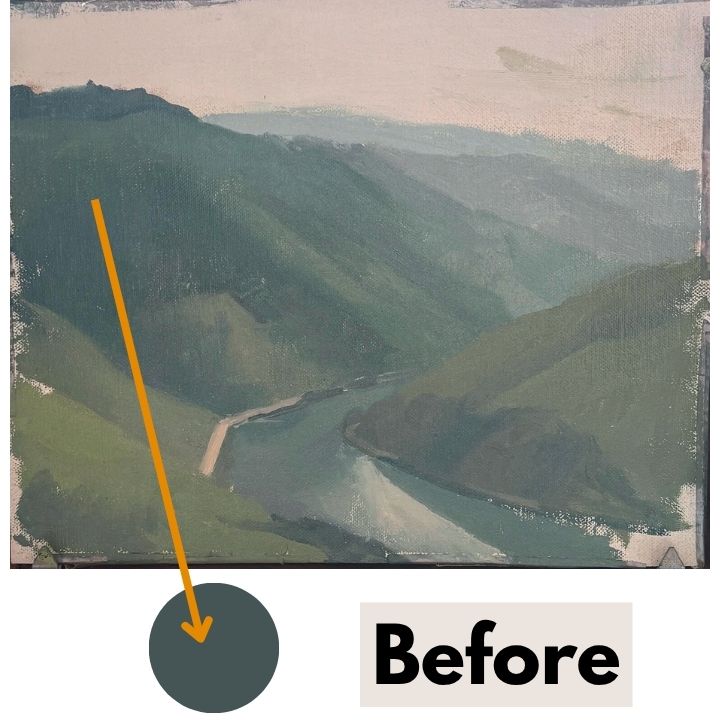
Lesson:
Resist the urge to push values too far in either direction when working with scenes that have subtle transitions. Capturing nuance can often say more than making a bold statement.
Fix:
A second session allowed me to lift some of the darker areas and refine the transitions, ultimately resulting in a painting that felt much more true to the experience of being there. I more or less painted over the entire piece, as the adjustments required reworking everything. Once one thing changes it often requires everything else to change.
Final Thought: Fewer Paintings, More Learning
It can be tempting to race through multiple paintings while traveling—especially in a new and inspiring location. But slowing down, revisiting work, and taking time to resolve issues leads to more satisfying results and deeper growth. I’d much rather come away from a plein air painting trip with two pieces I’m pleased with than four rushed ones that miss the mark.
Have you ever painted while traveling? Or visited Portugal?
I’d love to hear what you learned from painting in new environments—and how it shaped your process. Just leave me a comment below!
Want to remember this? Save these Plein Air Painting Tips to your favorite Pinterest Board.

19 thoughts on “Plein Air Painting Lessons from Portugal’s Douro Valley”
last year I travelled to Italy on a organized painting excursion and loved it – do you offer anything similar
I would love to offer an organized painting workshop someday in Italy or elsewhere. Unfortunately will not be doing anything like that anytime soon – but perhaps next year or the year after. Glad you were able to participate in an organized painting excursion – am sure it was wonderful!
Very interesting article, I was for a short holiday in Northern Romania, Maramures county (beautiful hills with forests and grazing areas, special clouds) and tried some sketches, using pencils or the I pad, I avoided to represent close and faraway hills but now I will try using photos.
Feel free to share what you make with the photo references you took from your trip there. Would love to see! Am glad you were able to make such a trip.
Thanks for publishing your Portugal pictures. You are right, it is important to step back from the painting and reassess what you have painted. This is why I like oil painting. I have to step back and wait until the oil dries before I can begin anew. This often gives me time to reassess mistakes and decide on corrective actions. I do landscapes mainly and they can be totally challenging.
Susan Pickel
Yes! I agree – oil paint is more forgiving in that way in that it allows you to change things more in the future. The greater flexibility with the medium has lots of rewards. Glad that you enjoyed this article – thank you for sharing.
Very interesting subject, this period I was on the go for about two weeks in Northern Romania , called Maramures county, (Poienile Izei ) where are beautiful hills with forests and grazing areas, and allways changing clouds.
I also tried to make some drawings using pencils, and try my skill using Ipad, I made plenty of photos. I thing I will try again home some subjects using memories and reading again yours plein air painting tips. I hope can try in my next trip the same subject 2 or 3 days.
Thank you Valentin! Very goo to hear from you. That is so wonderful that you got to take a trip to northern Romania. Yes you definitely should put your hand at it in your next trip to the location. But that is great that you did some drawings and also worked with your ipad with the landscape. Those are good steps in becoming acclimated with working in a plein air setting. Thank you for sharing!
I belong to the Box Butte Art Society in Alliance, Nebraska. We recently drove out to the Sand Hills a few miles north of Ashby, Nebraska. One of our members is friends with a rancher. We set up tables and chairs under a open tent.
We had all day to paint a windmill with a pond next to it or the rancher’s house and outbuildings at a distance. It also had a windmill, but you could only see the top portion of it.
I can see the color issues now that I’ve read this article. I won’t correct these paintings; I’ll just paint some new ones using the photos I took.
Thank you.
Hello. I am pleased with your trip to Portugal. I am portuguese and never stayed at Douro valley but have seen it on my way to somewhere in the north of my country.
I am very shy (or unsure) and delay the moment when I begin to sketch or paint, so I would need 3 or more days on site.
II hope you can come to see the vines covered in red leaves or in eraly spring to see the almond trees with white flowers near by.
Thank you so much for sharing! That would be lovely to someday see the vines covered in red leaves as well as the almond tree flowers! Don’t think I have ever gotten to see that before.
Beautiful and thoughtful study of subject .
Thank you.
Sharad kamble
Thank you so much!
I was there at the spot you painted from in early June! I was with my daughter and her husband . There was no time to paint. I did try, the wind kept blowing my brushes away, . Thought I
was going to lose them all!
Oh thats so great you were also in this area – how fun! Good for you that you did try – too bad it was so windy! It can be hard to find time to paint on family trips.
This was particularly useful, Elizabeth. And encouraging. Thank you.
So glad to hear that Nick – thank you for sharing!
I used to carry paints, sketching equipment & pastels on holiday with me & found painting to be rather awkward in Barbados. Then the next year I just took pastels which seemed easier to handle. Until we went to Bathsheba, on the Atlantic coast & a surfers heaven! As I tried to recreate the huge rolling waves along the coast the rather strong sea breeze was blasting pastel dust all over me! This holiday to Crete, I’ve just taken Aquarelle crayons & a small sketch book with a propelling pencil, eraser, biro & 3 different sized square brushes.
Easy to carry around & get through airports etc.
Oh wow! I could just imagine the sea breeze blasting all the pastel dust on you! That would make working with pastels quite difficult. Thats great you have found a system that works well for you. It can sometimes take a few tries to find something that is suitable.