


With fall just around the corner, we are heading into the season of art submissions! It is time to know how to submit artwork to exhibitions.
This is something I have been reminding myself of lately, as I have been wanting to get more serious about submitting my work to different exhibitions. And I thought it would be a wonderful opportunity to remind you of the same.
When we create art, it is meant to be shared.
This is an important part of the art-making process that is too easily forgotten. It is very easy to spend months—or even years—working away in the studio without putting much thought into what happens to the paintings afterward.
But there is a certain kind of motivation and energy that comes from sharing your work that nothing else can quite replace. Having a deadline to work toward, seeing your paintings hanging somewhere outside your own studio, meeting other artists, or even simply knowing that someone else is looking at your work can push you forward in ways that working entirely on your own cannot.

The difficult part, of course, is figuring out where to show your work in the first place.
There are seemingly endless calls for art, competitions, galleries, publications, residencies, and exhibitions out there. Which ones should you submit to? Which ones are worth the entry fee? And which ones should you completely avoid?
The process becomes much easier once you have a system.
Start With the Right Opportunities for Where You Are
You will have different goals depending on whether you are brand new to showing your work or already have a decent amount of exhibition experience.

You don’t want to apply to anything and everything, but rather be strategic about what you apply for. At the same time don’t be overly selective that you only apply to a few things. Find a good balance so that you cast your net wide enough and get accepted by some of your applications.
If you are new to showing your work, I would start by looking at opportunities in your local area.
Do you have a local art center? Community galleries? Regional art associations? Annual juried exhibitions? Perhaps there are restaurants, coffee shops, libraries, or other spaces that regularly show artwork.
Local and regional exhibitions can be a wonderful place to begin because they allow you to gain experience without the expense and complication of shipping paintings across the country. You also begin to meet other artists and people involved in the arts in your area—which can lead to opportunities you might never find through an online listing.
You can also search websites such as Creative West or EntryThingy, where you can filter opportunities by location, deadline, eligibility, and other criteria.

If you already have a history of showing your work—or simply want to begin expanding beyond your local area—start looking at exhibitions across the country or even internationally.
However, remember that an exhibition farther away can involve considerably more expense. You may have shipping costs both ways, framing requirements, insurance, entry fees, and sometimes additional exhibition costs. A $40 entry fee can quickly turn into several hundred dollars if your painting is accepted.
That doesn’t mean you shouldn’t apply. It simply means you want to be selective.
Don’t Apply to Everything

One of the most important parts of submitting artwork is actually deciding what not to apply to.
Before paying an entry fee, look up the gallery, museum, art center, or organization putting on the exhibition.
- Who has exhibited there previously?
- Who is judging or curating the exhibition?
- What kind of artwork do they normally show?
- Does your work seem like it would actually belong there?

Look through previous exhibitions if they are available. This can tell you quite a lot. If the organization consistently exhibits conceptual installation work and you paint traditional representational landscapes, for example, it might not be the best use of your submission fee—even if technically you are eligible to apply.
On the other hand, if you look through previous exhibitions and immediately think, my work could fit here, that is a much better sign.
You aren’t trying to change your work to suit every exhibition. You are trying to find the exhibitions that make sense for the work you are already creating.
Look Beyond Exhibitions

Exhibitions aren’t the only opportunities worth applying for.
Look for print publications, art magazines, competitions, grants, and artist residencies as well.
I have been very grateful to attend a number of artist residencies over the years, all of which were either completely free or even paid opportunities. Residencies can give you concentrated time to work, introduce you to other artists, and sometimes give you access to places or resources you otherwise wouldn’t have.
There are many different kinds of opportunities available to artists, so don’t limit yourself to gallery exhibitions alone.
Put Every Submission Deadline on a Calendar

This is probably one of the least exciting parts of learning how to submit artwork to exhibitions—but it may also be one of the most important.
Once you have a running list of exhibitions and opportunities you are interested in, write every deadline on a calendar.
Personally, I prefer using a monthly calendar rather than a weekly one. I want to be able to look at the entire month at once and immediately see what is coming.
Even better, look several months ahead. This way you can be the most prepared.
And keep an eye out for early-bird deadlines. Some exhibitions offer reduced submission fees if you apply early. If you already know that you want to enter, there is little reason to pay more simply because you waited.
Decide Whether an Opportunity Is Actually Worth It

As you compile your list, continually filter whether each opportunity is worth your time and money.
Unfortunately, not every opportunity marketed toward artists exists for the benefit of artists.
Watch out for vanity galleries and pay-to-play publications whose primary business seems to be collecting fees from artists rather than building a genuine audience for their work.
An entry fee itself isn’t necessarily a red flag. Juried exhibitions cost money to organize, and many completely legitimate organizations charge submission fees.
Instead, look at what you are potentially receiving in return.
- Does the gallery have a real audience?
- Does the exhibition have a history?
- Who is the juror?
- Is there meaningful publicity?
- Are there awards?
- Do people actually attend the exhibition?
- Is the organization respected within the kind of art world you want to be part of?
Also consider the total potential cost if you are accepted—not simply the entry fee. Shipping, framing, insurance, commission, and return shipping can all become part of the equation.
Sometimes an opportunity may still be worth pursuing even if you don’t expect to sell anything. Perhaps the juror is someone you respect, the exhibition would be a meaningful addition to your exhibition history, or it would put your work in front of an audience you genuinely want to reach.
The important thing is to know why you are applying.
Make the Work You Want to Submit
Once you have organized the opportunities you want to pursue, there is still one rather important thing left to do:
Make the actual work.
Having submission deadlines ahead of you can actually be incredibly helpful in the studio. Instead of endlessly thinking that you should “make more paintings,” you suddenly have something concrete to work toward.
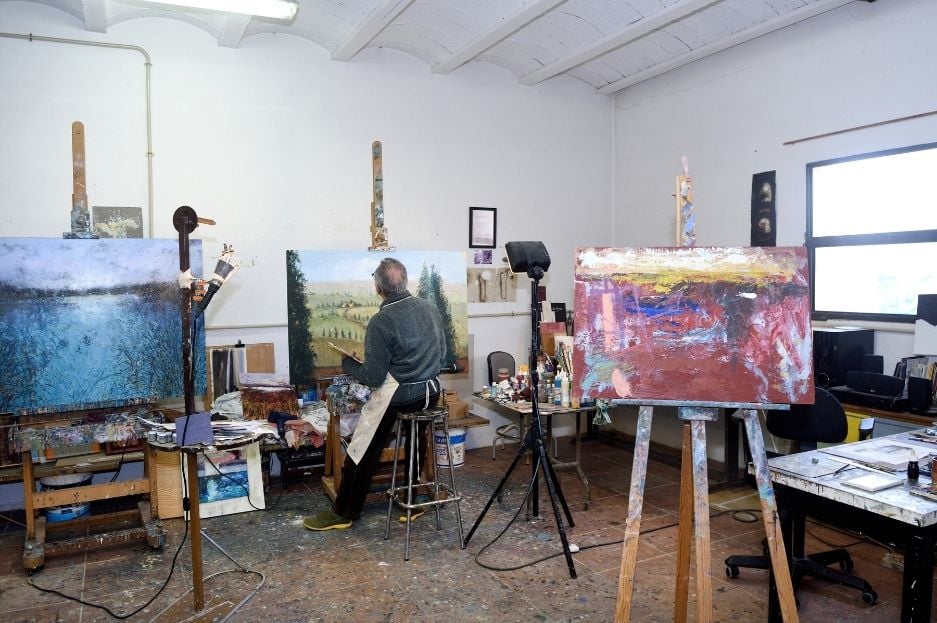
If possible, work toward developing a cohesive body of work rather than submitting a handful of completely unrelated paintings.
If an application asks for five images, you generally don’t want those five images to look as though they were made by five different artists. There should be some sort of through line connecting them.
That doesn’t mean every painting needs to look the same. But the work should begin to communicate something about who you are as an artist and what you are interested in.
This is one of the hidden benefits of applying to exhibitions: it forces you to step back from individual paintings and begin thinking about your work as a body of work.
Prepare Your Artwork Before You Need It
Don’t wait until the night before a deadline to figure out how to photograph your paintings.

Good documentation matters enormously.
Make sure you have high-resolution, color-accurate photographs of your artwork without distracting backgrounds, glare, or crooked edges. You may want to bring your work to a professional photographer, particularly for important applications, or learn how to properly photograph your artwork yourself.
Keep accurate information for each painting as well:
- Title
- Medium
- Dimensions
- Year completed
- Price
- Framing information
- High-resolution image
- Where the painting currently is
If a painting has already been sold, is at a gallery, or has been committed to another exhibition during the same dates, you obviously need to know that before submitting it somewhere else.
Keeping all of this information in one place makes future applications infinitely easier.
Prepare Your Artist Statement and Bio in Advance
Another thing you will want to work on well ahead of time is your artist statement and bio.
You will be asked for these again and again.
Instead of rewriting them from scratch every time you apply for something, create a strong master version of each that you can adapt when necessary.
I also find it helpful to keep versions of different lengths—a very short bio, a slightly longer bio, and a full version. Applications often have wildly different word or character limits.
The same goes for your artist statement.
Having these materials prepared means that when an interesting opportunity appears, you aren’t suddenly faced with writing an entire artist statement at 10:30 at night because the deadline is tomorrow.
Track Everything You Submit

Once you begin applying regularly, it becomes surprisingly easy to forget where you submitted what.
Keep a simple spreadsheet or document that tracks the opportunity, deadline, submission fee, paintings submitted, notification date, and whether the work was accepted or rejected.
If something is accepted, immediately add any additional deadlines to your calendar: framing deadlines, paperwork, shipping dates, exhibition dates, pickup dates, and return shipping information.
The goal is to make the administrative side of exhibiting your work as automatic as possible.
The less mental energy you spend trying to remember dates and details, the more energy you have for actually painting.
How to Deal With Rejection

And then, of course, there is rejection.
If you get accepted into everything you apply for, you aren’t applying to enough places.
Don’t be afraid of rejection. In some ways, welcome it.
Rejection is simply part of putting your work into the world. There are countless reasons why a painting might not be selected for an exhibition, many of which have very little to do with whether it is a “good” painting.
A juror may have hundreds or thousands of works to choose from. Your painting might not fit with the other work selected. Another artist may have submitted something similar. Your work may simply not fit that particular juror’s taste.
You usually won’t know.
So don’t allow every acceptance to convince you that your work is wonderful—or every rejection to convince you that it isn’t.
Treat submissions partly as a numbers game and partly as an administrative routine.
Apply. Record it. Move on. Keep painting.
Your Work Can’t Be Seen If You Never Put It Out There

Making the work will always be the most important part.
But at some point, we also have to allow the work to leave the studio.
That requires a different kind of courage and discipline than painting does. You have to find opportunities, fill out applications, pay fees, photograph paintings, meet deadlines—and hear “no” quite a few times along the way.
But this is part of being an artist too.
Your paintings cannot find their audience if no one ever has the opportunity to see them.
So as we head into another season of exhibitions and submission deadlines, start looking at what is out there. Find a few opportunities that genuinely make sense for your work. Put the deadlines on your calendar.
And then get back into the studio and make something worth submitting.

4 thoughts on “How to Find and Apply for Art Exhibitions (And Stay Organized)”
As allows Elizabeth….thank you for helpful information and teaching in a delightful manner 😊
Anne Koehler
You are so welcome! Very glad it is helpful 🙂
Elisabeth that is invaluable information thank you… You are so right about importance of showing your work and taking the plunge to try and get accepted at an exhibition.
You are so welcome! Very true – and it is something I have been reminding myself of lately.